 0
0
 0
0
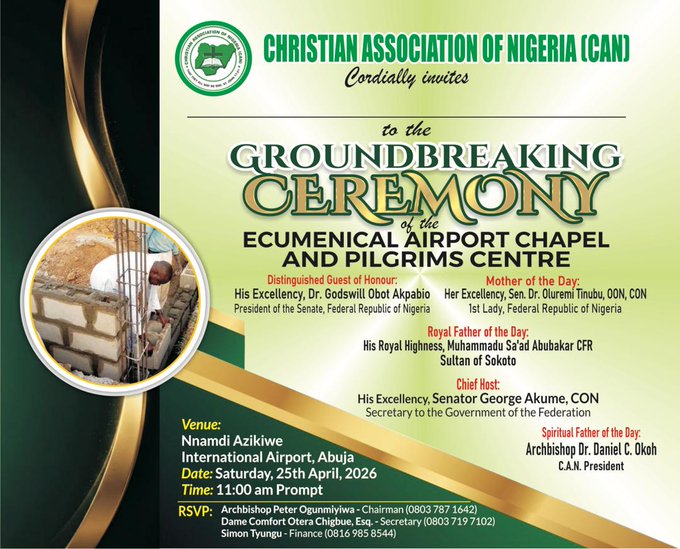
I consider the invitation of CAN to the Sultan of Sokoto, Muhammadu Sa’ad Abubakar, to serve as the royal father of the day at the foundation laying ceremony of Ecumenical Chapel at international airport Abuja with consternation. The gesture is repugnant to Christianity and constitutes a subtle but sophisticated onslaught on the psyche of Christians in Nigeria, no matter the intentioned. This is a classic of confusion of peace with theological compromise.
In a nation as religiously vibrant and sensitive as Nigeria, the call for peaceful coexistence among faiths is not only necessary—it is urgent. Our history, stained at different points by sectarian tensions, demands that we pursue harmony, mutual respect, and national unity.
Nowhere is this more evident than in the increasing trend of interfaith symbolism within explicitly Christian spiritual activities, particularly in events such as church foundation-laying ceremonies. This is not a trivial matter. It is a foundational one.
The Crisis: When Symbolism Becomes Theology
In view of the planned foundation laying ceremony of the Ecumenical Airport Chapel and Pilgrims Centre it has become necessary that the invitation extended to the Sultan of Sokoto as the “Royal Father of the Day” be addressed.
The fatherhood of a day is not a role that is shareable; the intrinsic spirituality of the role is not for sale nor is it a largesse of CAN President for exclusive expropriation. The Church being a platform and pillar of truth cum moral in the society should not be debased to bestow the sanctity of her essence to an individual who couldn’t rise up to fulfil the community fatherhood of his throne in Sokoto to protect Deborah Samuel from incendiarism.
I write to appeal to the CAN president and his team to reverse the invitation to Muhammadu Sa’ad Abubakar, the Sultan of Sokoto, to serve as the “Royal Father of the Day” to the foundation laying of a Christian chapel at the Nnamdi Azikiwe International Airport, Abuja. In case the CAN officials have forgotten, Sultan is the Leader of Nigerian Supreme Council of Islam Affairs in Nigeria.
Let us be clear: this is not merely a gesture of goodwill. It is a public theological statement. And the question must be asked: What exactly is being communicated to the faithful—and to the watching world?
The Apostolic Foundation Cannot Be Negotiated. The Christian Church, from its inception, has been unambiguous about its foundation; “For no other foundation can anyone lay than that which is laid, which is Jesus Christ.” (1 Corinthians 3:11) The Church is not built on: interfaith consensus, social diplomacy, political correctness. It is built on the exclusive lordship of Jesus Christ.
To symbolically hand over a foundational Christian act to someone who does not share that confession is to introduce ambiguity at the very point where clarity is most required. Peace Must Not Come at the Cost of Truth.
There is a difference between: coexistence and convergence, respect and endorsement, dialogue and doctrinal dilution.
Christianity commands love for all. It does not command the surrender of its core convictions in the name of peace; “What fellowship has righteousness with lawlessness? And what communion has light with darkness?” (2 Corinthians 6:14) This is not a call to division—it is a call to distinction.
The Danger of a Confused Generation
When such gestures are made in the public space, especially within sacred Christian ceremonies, they produce dangerous consequences:
1. Doctrinal Relativism; Young believers begin to internalize the idea that all religions are equal, truth is negotiable, Jesus is optional. This is not Christianity—it is philosophical pluralism disguised as faith.
2. Erosion of Spiritual Authority; Foundation-laying is not just ceremonial—it is symbolic of spiritual ownership, covenant alignment, divine dedication. When this moment is presided over by someone outside the Christian faith, the message becomes blurred: who truly defines the house?
3. Substitution of Witness with Appeasement. From the early times, the Church is planted in diverse societies but never dilutes its message. From Jerusalem to Athens, the Apostles did not co-officiate religious expressions—they proclaimed Christ with clarity, even at personal risk. Regrettably, today, CAN president risks replacing conviction with comfort.
Defining True Interfaith Engagement
Nigeria needs interfaith harmony—but it must be rightly defined. Interfaith engagement should focus on cooperation on national development, joint advocacy for peace and justice, respect for human dignity across beliefs, dialogue without hostility.
Interfaith must never become a shared spiritual authority in Christian worship, joint consecration of sacred acts, symbolic gestures that imply theological unity. Because when everything is blurred, nothing remains sacred.
A Call to CAN Leadership in Nigeria
This is a moment for sober reflection among Christian leaders across Nigeria. We must ask: are we building churches or managing perceptions, are we preserving truth or performing diplomacy, are we leading people or confusing them? The Church must be: loving, but not compromising; peaceful, but not ambiguous; inclusive in compassion, but exclusive in its foundation.
Conclusion: The Foundation Determines the Future
A building can be renovated; a reputation can be repaired. But a faulty foundation threatens everything. The Church must remember: it is not called to blend; it is called to stand. It is not called to offend, neither is it permitted to obscure the truth. In a time when Nigeria desperately needs peace, the Church must contribute not by diluting its message, but by living it with clarity, courage, and conviction. Because in the end, a confused Church cannot be regarded as the ground and pillar of truth and moral in the society, neither can it heal a divided nation.
@PastorEAAdeboye
@_PastorUmoEno
@Bishopoyedepo2
@KukahBishop
@pastortonye1
#christapostolicchurch.
SB E-news.


About the Author