 0
0
 0
0
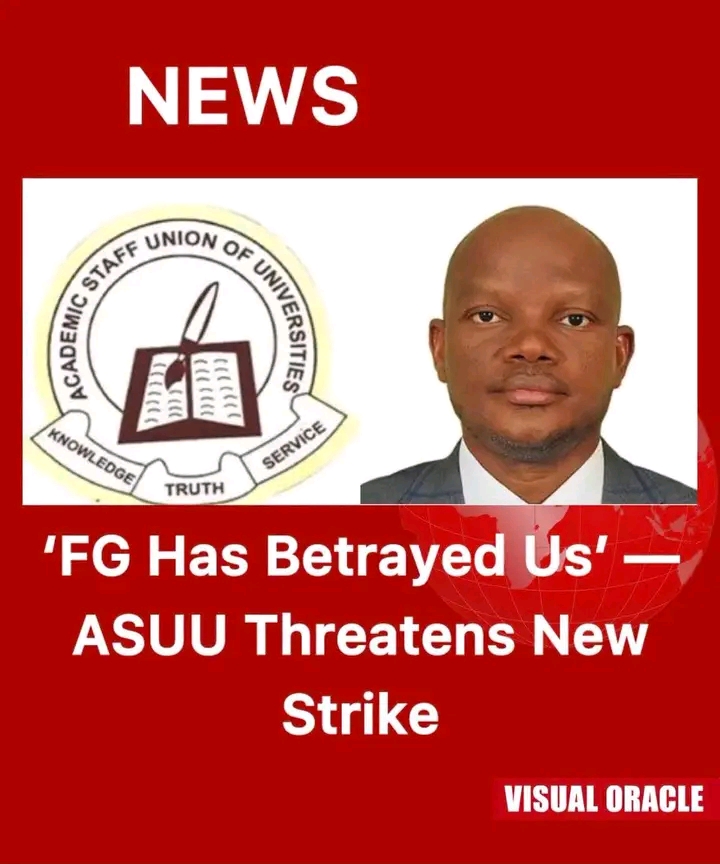
The Academic Staff Union of Universities (ASUU) has issued a strong warning of potential industrial action, accusing the Federal Government of a flawed and partial implementation of the landmark 2025 FG-ASUU Agreement signed in December 2025.
The union described the government’s handling of the deal as a betrayal that risks plunging Nigeria’s public universities into another wave of disruption.
Rising from its National Executive Council (NEC) meeting held at Modibbo Adama University, Yola, ASUU President Prof. Christopher Piwuna told journalists in Abuja that the “momentum generated by the agreement was fast waning.”
He warned that “the increasing frustration occasioned by the seeming government’s disinterestedness in the welfare of Nigerian academics is brewing a pent-up anger which could erupt into a new wave of industrial unrest if not addressed.”
The agreement, reached after nearly eight years of protracted negotiations that effectively addressed the long-stalled 2009 pact, took effect from January 1, 2026.
Key provisions included a 40 per cent upward review of academic staff emoluments largely channelled through a new Consolidated Academic Tools Allowance, or CATA, covering research tools, publications, conferences, and related needs, restructured Earned Academic Allowances (EAA) tied more transparently to duties performed, a new Professorial Cadre Allowance (approximately N1.74 million annually for professors and N840,000 for readers), improved pension arrangements, and frameworks for better university funding and governance. It was widely hailed at the time as a potential end to the cycle of strikes that had repeatedly disrupted Nigeria’s tertiary education system.
ASUU, however, maintains that implementation has been selective and incomplete. The union condemned the Federal Government’s failure to inaugurate the Implementation Monitoring Committee (IMC), which was intended to oversee faithful execution and prevent bureaucratic sabotage.
According to the union, federal universities have been “picking and choosing” which components of entitlements such as CATA, EAA, and Professorial Allowances to pay, while many state governments have largely ignored the agreement despite their representatives’ participation in negotiations. Beyond the new pact, ASUU listed a catalogue of unresolved legacy issues fuelling discontent.
These include the withheld three-and-a-half months’ salaries from the 2022 strike (enforced under the “No Work, No Pay” policy), promotion arrears, salary shortfalls linked to the Integrated Personnel and Payroll Information System (IPPIS), unremitted third-party deductions, and outstanding arrears of the earlier 25–35 per cent wage award. The union also raised concerns about pension harmonisation delays and the plight of retired academics, particularly from state universities.
“No country can progress when the welfare issues of its academics are left unattended,” the union declared, accusing authorities of treating scholars “like menial workers.”
ASUU appealed to “genuine patriots, well-meaning Nigerians and lovers of Nigeria” to prevail on both federal and state governments to fully implement the agreement and resolve outstanding matters in the interest of students, parents, and the nation. While keeping its doors open for dialogue, the NEC directed that an emergency meeting be convened within weeks to review the situation and determine appropriate action.
SB E-news.


About the Author