 0
0
 0
0
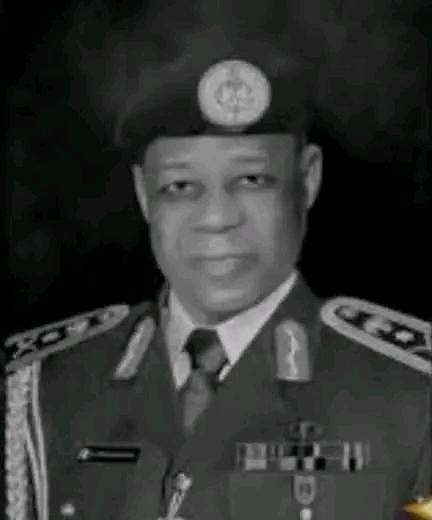
Aliyu Mohammed Gusau (born 18 May 1943) stands as one of the most influential figures in Nigeria’s military and political history. A general, statesman, intelligence strategist and political actor, he shaped the nation’s security institutions across several decades and played a crucial role in Nigeria’s transition into the Fourth Republic. His influence extended across successive military governments and early civilian administrations, establishing him as one of the most enduring and consequential actors of Nigeria’s post-independence era.
Born on 18 May 1943 in Gusau, present-day Zamfara State, Aliyu Mohammed was raised in northern Nigeria at a time when the region was experiencing transformative social and political changes. The Nigerian Army later appended “Gusau’’ to his official records to distinguish him from another senior officer bearing the same name, creating the widely used public identity “Aliyu Mohammed Gusau.” Although he personally preferred to use only “Aliyu Mohammed,’’ the extended name became a fixture in media, political commentary, and national historical writing.
Aliyu began his military journey in 1964 when he enrolled as an officer cadet at the Nigerian Defence Academy, Kaduna. Three years later, he was commissioned into the Nigerian Army as a second lieutenant and immediately found himself amid the turbulence of national conflict. In 1967, when the Nigerian Civil War broke out, he was among the young officers deployed to the front lines. The war would shape his early military worldview, deepening his understanding of security, intelligence, and the fragility of national unity.
By the late 1970s, Aliyu had become one of the Army’s most trusted officers. He commanded the 9 Infantry Brigade in Abeokuta from 1976 to 1978, then served as Adjutant General of the 2 Mechanised Division until 1979. Later that year, he was appointed Director of Personnel Services at Army Headquarters, marking his steady rise into the ranks of senior leadership.
His first major national role came in November 1979 when he was appointed Director of Military Intelligence (DMI). For the next four years, he became a central figure within Nigeria’s intelligence community. His insights and strategic coordination contributed significantly to the planning of the 31 December 1983 coup that removed President Shehu Shagari, ending the Second Republic and bringing Major-General Muhammadu Buhari to power. But the political tensions of the new administration quickly placed him at odds with the new leadership. Although nominated to head the National Security Organisation (NSO) with the support of the Chief of Army Staff, Ibrahim Babangida, Buhari rejected his appointment. Aliyu was removed as Director of Military Intelligence and replaced with Colonel Halilu Akilu.
Despite the setback, he remained influential. Aliyu attended the Royal College of Defence Studies in the United Kingdom, and upon his return became a pivotal participant in the 27 August 1985 coup that overthrew Buhari and elevated Babangida to power. Following the successful takeover, he was appointed Director of the Defence Intelligence Agency (DIA) and Acting Director-General of the NSO. Between 1985 and 1989, he reorganised the entire intelligence structure, breaking the NSO into the three security institutions that remain the backbone of Nigeria’s intelligence framework today: the State Security Service (SSS), the National Intelligence Agency (NIA), and the Defence Intelligence Agency (DIA). This restructuring remains one of his most enduring contributions to Nigerian governance.
Aliyu continued to occupy critical positions: General Officer Commanding 2 Mechanised Division in Ibadan (1989–1990), Chief of Administration at Defence Headquarters (1990–1992), and Commandant of the Nigerian Defence Academy (1992–1993). His leadership was recognised once again in January 1993 when he was appointed National Security Adviser (NSA), a role he later combined with Chief of Army Staff during the brief civilian interlude of the Third Republic under Ernest Shonekan.
When General Sani Abacha seized power in November 1993, Aliyu was removed as Chief of Army Staff and retired from the military. He transitioned into civilian life by launching Alpha Public Affairs Consultancy, where he remained chairman and chief executive from 1993 to 1999. Even in retirement, his influence within both military and civilian political circles remained strong. His behind-the-scenes guidance proved instrumental during Nigeria’s historic transition to democracy in 1999.
President Olusegun Obasanjo appointed him National Security Adviser once again in 1999, a role in which he supervised the controversial but decisive retirement of former military political office holders, ensuring the civilian presidency had full control of the armed forces. He held the position for most of Obasanjo’s administration and competed in the 2006 PDP presidential primaries, finishing third.
Goodluck Jonathan reappointed him NSA on 8 March 2010 during a period of national tension. His early meetings with service chiefs centred on addressing the Jos crisis and general insecurity. Publicly, he criticised the weaknesses of the legal system, the inefficiencies of the law-enforcement apparatus, and the selective nature of anti-corruption efforts—comments that reflected his broad understanding of Nigeria’s governance challenges. In 2010, he declared his intention to run for president in the 2011 elections.
Beyond public service, Aliyu has contributed to intellectual development through the establishment of the Gusau Institute in Kaduna. Donating his extensive private library and collections, he created a platform for research, policy analysis and national development dialogue. His family life also features in Nigeria’s contemporary political landscape; his son, Mahdi Mohammed Gusau, served as Deputy Governor of Zamfara State from 2019 until 2022.
Today, Aliyu Mohammed Gusau remains one of the most studied figures in Nigeria’s military and political history. His career spans the Civil War, several coups, national security transformations, multiple republics, and democratic transitions. His role in designing modern Nigeria’s intelligence structure, coupled with his influence across both military and civilian regimes, places him among the key architects of the nation’s political evolution.
Sources
Nigerian Defence Academy archival records
Nigerian Army senior officers’ service profiles
Federal Government publications on the restructuring of the National Security Organisation (1986).
SB E-news.


About the Author