 0
0
 0
0
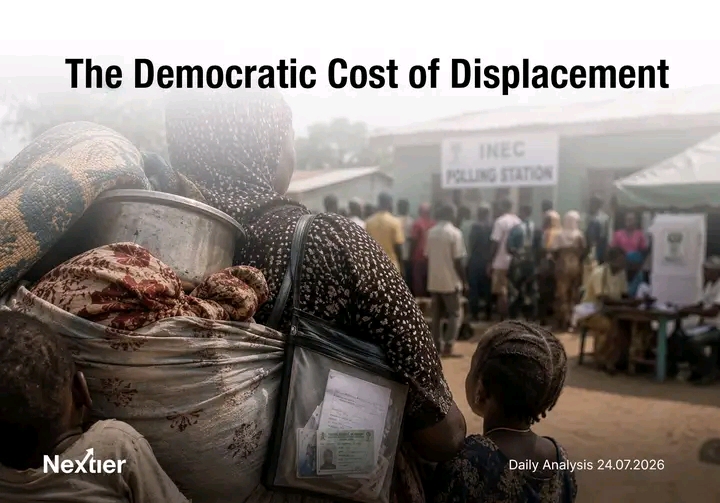
Officials in Niger State said as much, promising that “no eligible Nigerian will be disenfranchised.” It is the sort of assurance that has been made before, in almost identical language, ahead of almost every election since 2015. The gap between that promise and reality on the ground is where this story begins.
By the time Nigerians go to the polls on 16 January and 6 February 2027, the country’s population of internally displaced people will likely exceed the 3.8m estimated by the UN refugee agency, up from roughly 2.7m before the 2023 election. That growth is not incidental. It tracks almost exactly with the deterioration of security in the North West and North Central regions, where banditry, farmer-herder violence and jihadist insurgency have displaced entire wards, not just households.
The scale of what is now at stake for the electoral process is becoming clearer state by state. In Plateau, the Resident Electoral Commissioner recently disclosed that nearly 47,000 registered voters have been displaced by violent attacks, scattered across 29 of the state’s 95 registration wards.
In the North West, security sources cited by local media estimate that more than five million registered voters, using the 2023 national total of 93million as a baseline, live in local government areas where safe access to a polling unit cannot currently be guaranteed.
In Zamfara alone, more than 100 communities across all 14 local government areas are said to remain under the influence of armed groups, despite years of military campaigns.
These are not marginal rounding errors in a country of 220m people. They are a meaningful share of the electorate, concentrated precisely in the regions where grievance against the Nigerian state already runs deepest. Disenfranchising them does not merely deny individuals a ballot; it systematically mutes the constituencies most affected by insecurity from having any say in how that insecurity is addressed. The people least served by the state are, by design or by neglect, the ones least able to hold it accountable.
Nigeria is not without a legal architecture for this problem. INEC’s 2018 regulations for voting by internally displaced persons allow for dedicated voting centres in recognised camps, and Nigeria is a signatory to the African Union’s Kampala Convention, which obliges the state to protect displaced citizens’ political rights. Yet architecture is not the same as practice.
A 2015 precedent still haunts the debate: INEC that year attempted to bar electorates in Adamawa, Borno and Yobe from voting, a decision former Chief Justice Uwais called “trouble” driven by administrative convenience rather than principle.
Camp coordinators in Benue, Kaduna and Cross River told local reporters after the 2023 election that INEC officials simply never arrived to register residents or resolve faulty voter cards. The framework existed on paper.
Follow-through did not.
There are, to be fair, signs of a more serious effort this general elections cycle. Continuous voter registration has been extended into IDP camps in the Federal Capital Territory and Benue, often in partnership with civil-society groups. That such basic gaps are only being addressed now, a year out from a general election, says something about the order in which Nigerian institutions rank their priorities.
The deeper pattern is one of chronic afterthought. Displaced Nigerians reliably enter the national conversation as a humanitarian statistic, camp populations, malnutrition rates, cholera outbreaks, and rarely as a political constituency whose exclusion has consequences for legitimacy. Election observers, donors and INEC itself tend to treat IDP inclusion as a logistical footnote to be resolved closer to polling day, rather than as a structural failure requiring investment on the same timeline as any other electoral reform. That sequencing consistently produces the same outcome: last-minute registration drives, patchy camp coverage and a commission that discovers the scale of the problem only when journalists or NGOs do the counting it did not.
Nigeria’s 2027 election will be judged, as its predecessors were, on turnout figures and the absence of overt violence at polling units, the metrics that make for a clean headline and a passable communiqué from international observers.
Those metrics are also the easiest to manage, since a state can suppress visible violence at the ballot box simply by ensuring that the people most likely to encounter it never reach one.
It should also be judged on a harder question, one that neither INEC nor its foreign election-monitoring partners has shown much appetite for asking: whether the millions of Nigerians the state has already failed to protect from bandits, insurgents and communal violence are the same millions it now fails to count as citizens with a vote.
NEXTIER.
SB E-news.


Related posts:
INTERNAL SECURITY: POLICE SUSTAINS FIGHT AGAINST VIOLENT, ORGANIZED CRIMES; NEUTRALIZES 7 TERRORISTS...
ASSOCIATION OF PROFESSIONAL WOMEN BANKERS SET TO HOST 2024 EVENT ON POSITIONING FOR ECONOMIC SHIFTS ...
RE-GAZETTING A FORGED LAW IS NOT REFORM , IT IS A CONSTITUTIONAL COVER-UP- Chief Malcolm Emokiniovo ...
About the Author