 0
0
 0
0
The tech industry loves to talk about “the cloud” as if it were some magical, invisible thing floating in cyberspace — something abstract, untouchable, and beyond the physical world.
But the reality is very different.
The “cloud” is not floating in the sky. It is not abstract. It is not mystical.
The cloud runs on data centers.
Those data centers have physical locations.
They have street addresses.
And anything with an address can be hit by a drone or a missile.
So the industry should stop pretending.
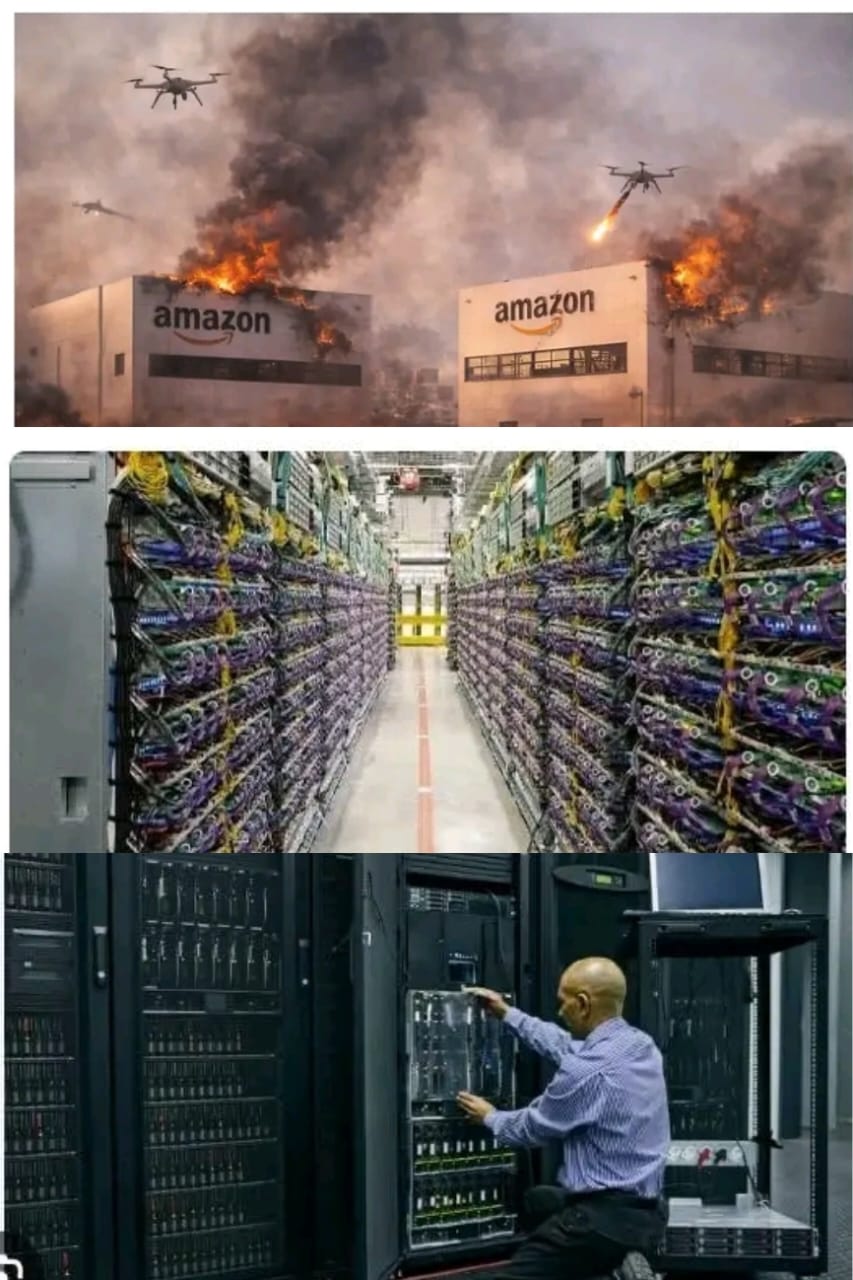
These facilities are not clouds. They are massive warehouses filled with servers, machines, power systems, and cooling infrastructure. They are industrial facilities — and increasingly they are strategic infrastructure.
And they consume enormous resources to operate.
Data centers require huge amounts of water to function. A typical mid-sized data center consumes roughly 300,000 to 500,000 gallons of water every single day. Large hyperscale facilities can consume between 1 million and 5 million gallons per day.
That amount of water is roughly equivalent to the daily water consumption of a town with 10,000 to 50,000 residents.
Why Data Centers Use Water
While data centers are primarily powered by electricity, water is essential for several key functions.
Cooling Systems
Servers generate extreme heat that must be removed constantly to prevent equipment failure. One of the most common methods is evaporative cooling — spraying water into the air to cool the systems. It is more energy efficient than traditional air conditioning, but it consumes significantly more water.
Indirect Electricity Generation
Much of the water footprint of a data center is indirect. The electricity powering these facilities often comes from thermoelectric power plants — coal, natural gas, or nuclear — which require massive amounts of water to produce steam and to cool turbines.
So the “cloud” is actually powered by enormous industrial infrastructure that consumes electricity, land, and water at massive scale.
And now that infrastructure is becoming a battlefield.
Last week, three data centers operated by Amazon Web Services (AWS) — two in the United Arab Emirates and one in Bahrain — were struck by Iranian drones or missiles. The attacks forced the facilities offline and triggered service outages affecting banking systems, payment networks, delivery applications, and enterprise software across the region.
The U.S. military also uses AWS infrastructure to run some of its workloads. This includes running Anthropic’s AI model Claude for certain intelligence functions.
Iran’s Fars News Agency claimed on Telegram that the Bahrain facility had been deliberately targeted “to identify the role of these centers in supporting the enemy’s military and intelligence activities.”
Amazon has declined to comment on that claim, and it remains unclear whether the strikes disrupted U.S. military computing operations.
But what is clear is this: this may be the first time data centers have been deliberately targeted in air strikes during a conflict.
And it almost certainly will not be the last.
Data centers are rapidly emerging as strategic assets — and therefore strategic targets.
The line between commercial cloud computing and military infrastructure has essentially disappeared.
The Pentagon’s Joint Warfighting Cloud Capability and its Joint All-Domain Command and Control systems run on the same commercial infrastructure that serves banks, logistics platforms, and ride-hailing apps.
Several reports indicate that the U.S. military used Anthropic’s AI model Claude — running on AWS — for intelligence analysis, target identification, and battlefield simulations during the Iran strikes.
That means commercial infrastructure is now directly tied to military operations.
When that happens, commercial targets become military targets.
Researchers are already warning about this new reality.
Zachary Kallenborn, a PhD researcher at King’s College London, told Fortune that if data centers become critical hubs for transmitting military information, adversaries will increasingly target them through both cyber attacks and physical strikes.
Kallenborn recently co-authored a study in the journal Risk Analysis examining globally critical infrastructure — including data centers and subsea cables — that function as choke points for both civilian economies and military systems.
He said that after speaking with senior officials around the world, he found something deeply troubling:
“Basically no one is thinking about these risks in a systematic way.”
Missile Defense for Data Centers?
Most data centers today have physical security measures — but they were designed for a different threat environment.
High fences with barbed wire.
Controlled access gates.
Security cameras.
All designed to stop a person on the ground.
None of it stops drones or missiles.
Data centers are large, visible complexes that rely on exposed infrastructure such as cooling towers, diesel generators, and gas turbines.
And those systems can be disabled without even hitting the server halls themselves.
“If you knock out some of the chillers you can take them fully offline,” said Sam Winter-Levy of the Carnegie Endowment for International Peace.
Some analysts now say data centers in volatile regions may need actual missile defense systems.
Chris McGuire, a former technology policy advisor at the U.S. National Security Council, told the Guardian that if companies plan to build massive AI infrastructure in the Middle East, they may need to consider defending it like military assets.
“If you’re actually going to double down in the Middle East, maybe it means missile defense on data centers,” he said.
And the vulnerability extends beyond the buildings themselves.
Seventeen submarine internet cables pass through the Red Sea, carrying the majority of data traffic between Europe, Asia, and Africa.
At the same time, Iran has closed the Strait of Hormuz and Houthi forces are threatening shipping lanes in the Red Sea.
Two of the world’s most critical digital choke points are now sitting inside active conflict zones.
Doug Madory, director of internet analysis at network intelligence firm Kentik, warned that shutting both routes simultaneously would be globally disruptive.
“I’m not aware of that ever happening.”
All of this is unfolding just as the Gulf region is attempting to position itself as a global hub for artificial intelligence.
During a tour of the region last year, President Donald Trump announced more than $2 trillion in investment pledges, including plans for the massive Stargate AI campus in Abu Dhabi — expected to become the largest AI facility outside the United States.
Amazon also committed $5 billion to build an AI hub in Saudi Arabia.
For now, the factors attracting tech companies to the Gulf remain unchanged: cheap energy, massive investment capital, and strategic geography.
But analysts say the recent strikes may be a preview of the future.
Physical attacks on data centers are likely to become more common as artificial intelligence becomes more strategically important.
Winter-Levy called the recent strikes “a harbinger of what’s to come.”
And he warned that this trend will not be limited to the Middle East.
The so-called cloud has entered the battlefield.
SB E-news.


About the Author